Showing posts with label Freedom of Expression. Show all posts
Showing posts with label Freedom of Expression. Show all posts
Monday, 25 April 2016


Wednesday, 14 October 2015
Wednesday, 27 May 2015
What Is The Human Rights Act And Why Does It Matter?
The Human Rights Act is a law that protects all of us from having our human rights taken away by the state. It means that public authorities have a legal obligation to uphold our human rights. A public authority is, for example, a hospital, school or the government. And everyone is protected. So, if you’re disabled, in hospital, accused of a crime, seeking refuge, homeless, gay, straight, religious, secular, snooped on, in the Army, a neglected child or a victim of trafficking, then you will have rights under this law to be treated properly and with dignity.
Read the full article on rightsinfo.org
Thursday, 23 April 2015
Free speech
This blog offers "news and views" from Kingsley, for the most part my news and views but that needn't be so. Since the beginning it's been made clear that anyone with a genuine connection to or interest in Kingsley can write on the blog and of course anyone at all can comment.
If you'd like to post articles on the blog fill out the form or contact me some other way and I'll setup credentials for you to post directly to the web. If you want to post but not using the technology yourself, email your articles to me and I'll post them for you. You can post under your real name or a 'handle' although in the case of the latter I'd need to know your real name. You're entirely responsible for your words so I'll need to pass on the writ if you get it wrong.
If you think that content posted here is biased or unfair you have three remedies:
1) Feel free to rebut anything you consider to be out of order. If you do that anonymously in a whingeing fashion, your complaint is likely to be treated with contempt.
2) If you work a little harder you might understand why you're wrong.
3) You can ignore it. Somewhere on the internet someone will always be disagreeing with you, sometimes that person will be me.
Wednesday, 22 April 2015
Human rights myth busting
The new rightsinfo.org project launched last night providing an entrance for laymen into the world of human rights legislation and practice.
One feature is its 14 worst myths visualization which explodes myths such as "Police give fried chicken to a buglar because of his human rights".
Another area builds a list of the top 50 human rights cases everyone should know about.
One feature is its 14 worst myths visualization which explodes myths such as "Police give fried chicken to a buglar because of his human rights".
Another area builds a list of the top 50 human rights cases everyone should know about.
Sunday, 1 March 2015
Universal Declaration of Human Rights
Whereas recognition of the inherent dignity and of the equal and inalienable rights of all members of the human family is the foundation of freedom, justice and peace in the world,
Whereas disregard and contempt for human rights have resulted in barbarous acts which have outraged the conscience of mankind, and the advent of a world in which human beings shall enjoy freedom of speech and belief and freedom from fear and want has been proclaimed as the highest aspiration of the common people,
Whereas it is essential, if man is not to be compelled to have recourse, as a last resort, to rebellion against tyranny and oppression, that human rights should be protected by the rule of law,
Whereas it is essential to promote the development of friendly relations between nations,
Whereas the peoples of the United Nations have in the Charter reaffirmed their faith in fundamental human rights, in the dignity and worth of the human person and in the equal rights of men and women and have determined to promote social progress and better standards of life in larger freedom,
Whereas Member States have pledged themselves to achieve, in co-operation with the United Nations, the promotion of universal respect for and observance of human rights and fundamental freedoms,
Whereas a common understanding of these rights and freedoms is of the greatest importance for the full realization of this pledge,
Full text of Universal Declaration
Friday, 27 February 2015
Human Rights - 11 real-life examples
Adam Wagner, of UK Human Rights Blog fame, has a new project: the Human Rights Information Project.
The aim of the project is to ‘change the face of human rights’ and
counteract poor public understanding of human rights.
Adam has asked people to nominate upto fifty human rights cases by 5pm today. The criteria are that the case must be a domestic or European human rights case, and it must have had a ‘profound impact on people in the UK’ or have the potential to do so.
Adam has asked people to nominate upto fifty human rights cases by 5pm today. The criteria are that the case must be a domestic or European human rights case, and it must have had a ‘profound impact on people in the UK’ or have the potential to do so.
Here's the eleven I submitted:
1. Regina v Brown and others [1992] UKHL 7 (11 March 1993)
An imperfect case in many ways but the first which made me seriously consider the
dividing line between the rights of the state and the rights of the
individual with respect to an individual's own body. A group of homosexual sadomasochists met
in private for what they considered to be fun but the courts
considered malicious wounding.
R v Brown was
concerned with the individual's wish to abuse his own body. This case
concerns the state's wish to abuse his body. A 15 year old on the
Isle of Man was sentenced to three strokes of the birch, a punishment
which the ECHR ruled amounted to degrading punishment within the
meaning of Article 3
After
9/11 the government took power
to detain indefinitely on reasonable suspicion without charge or
trial “ suspected
international terrorists”. The
House of Lords ruled that the state had effectively ordered arbitrary
detention without trial and did so on a discriminatory basis contrary
to ECHR Articles 5 & 14.
4. Young, James and Webster v. The United Kingdom (7601/76) (13 August 1981)
The ECHR found breach of Article 11 (right to [not] join trade unions) with respect to closed shop agreement at British Rail upholding the rights of the individual over the majority.
The ECHR found breach of Article 11 (right to [not] join trade unions) with respect to closed shop agreement at British Rail upholding the rights of the individual over the majority.
The ECHR found breaches of Articles 6 (fair hearing) and 8 (respect for family life) in respect of a child removed from its mother at birth and giv en up for permanent adoption.
The ECHR found breaches of Articles 3 (inhuman or degrading treatment) and 13 (effective remedy) in respect of social services failure to protect children from neglect amounting to inhuman treatment.
7. Mcshane v. The United Kingdom (43290/98) (28 August 2002)
The ECHR found breaches of Articles 2 (right to life) and 34 (interference in due process) in respect of the death of a civilian caused by negligent or intentional action of a soldier in Londonderry.
The ECHR found breaches of Articles 2 (right to life) and 34 (interference in due process) in respect of the death of a civilian caused by negligent or intentional action of a soldier in Londonderry.
The Supreme Court ruled deprivation of liberty in two cases of mentally incapacitated individuals living in warden-controlled restricted housing.
Night flights at Heathrow increased. ECHR approved consultation process and found no breach of Article 8 (respect for home and family life) but breach of Article 13 (remedy). The ECHR's approach involved examining UK procedure, not second-guessing outcome.
10. Bull and another (Appellants) v Hall and another (Respondents) (27 November 2013)
11. R (on the application of Laporte) (FC) (Original Appellant and Cross-respondent) v. Chief Constable of Gloucestershire (Original Respondent and Cross-appellant) (13 November 2006)
Three coachloads of anti-war protestors turned away to prevent breach of peace. House of Lords found breaches of Articles 10 (Freedom of expression) & 11. (Peaceful assembly).
The Human Rights Act 1998 established right to assemble & protest, proper test of police action was imminence of breach of peace and necessary restrictions not reasonableness of response.
Christian
hoteliers refused double bed to same-sex couple in civil partnership.
Convention Articles 9 (religious freedom), Article 14
(discrimination) and Article 8 (private life) were considered by the
House of Lords finding against the hoteliers and in favour of the
couple.
Three coachloads of anti-war protestors turned away to prevent breach of peace. House of Lords found breaches of Articles 10 (Freedom of expression) & 11. (Peaceful assembly).
The Human Rights Act 1998 established right to assemble & protest, proper test of police action was imminence of breach of peace and necessary restrictions not reasonableness of response.
Thursday, 8 January 2015
Je Suis Charlie
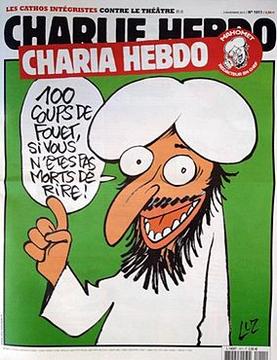
In common with other publishers, today we publish one of Charlie Hebdo's front covers.
No expression of opinion gives anyone the right to express their displeasure with violence.
Subscribe to:
Posts (Atom)